Thursday, 18 February 2016

SAISA Badminton 2016

This year for the 3rd ASA Quarter I had a hard time choosing what SAISA sport I would do that season. Traditionally I have tried out for the U19 girls’ basketball team and for the past two years the sport has been very enjoyable for me. However this year I decided to try out for a less stressful sport as this is my last year and my academics are more important than a sport that leaves me too exhausted to work properly at the end of the day. Therefore this year I chose to try out for the badminton team.

(Photo credit: Ms Lockwood)

Even though it’s not as popular an activity as the gendered sports at this school, I found that playing badminton was very enjoyable as it reminded me of tennis (which I have not played in years) and because it is a game that not only requires athletic ability and skill but it is also necessary to create strategies on the spot and play accordingly. In many of the sports I have played previously, such as with volleyball, basketball and football, it was not necessary for me to think on my feet or change a play or strategy at will because of my usually defensive positions (for example, defender in football and post in basketball). Another difference is that those are team sports that rely almost entirely on teamwork, but for badminton the only time teamwork is necessary is when you play with a partner.
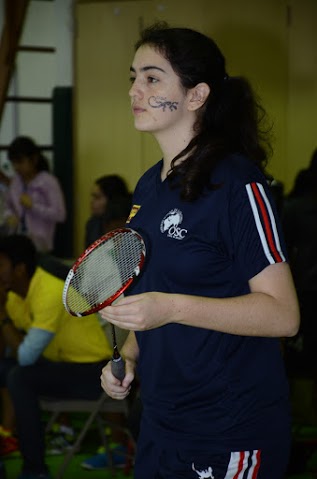
(Photo credit: American School of Bombay)

In SAISA there are the team placements and the individual placements. In these placements are three categories of games an individual player can enter in and those are singles, doubles and mixed doubles. And in those categories are sub-categories for player levels; seed 1 to 4. Even though this was my first year playing SAISA badminton (and badminton in general) I was placed in seed 1 as a learning experience and to lessen the pressure that comes from being a first time player and focus only on gaining skills.

(Photo credit: American School of Bombay)

(Photo credit: American School of Bombay)

Needless to say I lost all my singles matches for the team placement matches but I am happy to say that I improved a lot during each match as the point differences between myself and my opponents decreased with every match. This improvement was also evident during the individual placements as I won a few of my matches before losing during the quarter finals. Although I am not happy with my performance during the beginning of the match as the score was 2 to 11, I was able to win back 6 points during a streak in the second half and this was largely due to using my brain to change and think up strategies on the spot, like changing the placement of the shuttlecock at the last second.

(Photo credit: American School of Bombay)


In the end, our school came 3rd in the team placements and the only individual placement we won was for 3rd place for the girls’ doubles matches for my partner Rishika and me. The whole tournament was a lot of fun and a great learning experience. I am also very happy about finding out that this sport can be played by people of all ages, so I’ll be able to play badminton for a long time after school.

(Photo credit: American School of Bombay)

(Photo credit: American School of Bombay)

Thursday, 21 January 2016

Issues of Global Importance

Global Importance of Chess

The Checkmates as a service group have a link to the CAS Learning Outcome of global importance through its universal educational value. The game of chess which we play and teach to children from local schools is very important and is played on an international level because of these reasons:
  • Can be played by people of all ages and backgrounds
  • Works as a mental exercise that helps to improve critical thinking and learning abilities
  • Teaches strategy and discipline
  • In some cases it helps improve a child’s self confidence
  • Increases a person’s memory skills
  • Helps improve concentration and academic performance
  • Has been successfully used in therapy as recreational therapy
  • It’s a fun board game
On a more local level, chess is important in Sri Lanka because of its potential to gain an accomplished player a good school scholarship or recommendation. That is the service groups ultimate goal, to get an exceptional player a chess scholarship to a good school.

Thursday, 19 November 2015

Quarter 2 Extracurricular Activities

This quarter I planned to continue with my creativity and service activities of piano lessons and the Checkmates service group (Showing perseverance and commitment), while changing tracks for activity from volleyball to basketball as the previous season ended, like I did last year and the year before. However, my plans were thrown for a loop when I discovered that the SAISA tournament and the mock exams are only a few days apart, as well as the fact that the badminton season would occur at the same time but on different days of the week.

Originally I wanted to not take part in any SAISA to focus on my academics, but ultimately decided that since the tournament takes place only after the mock exams instead of before, then it was okay to take part in a SAISA sport one last time. This year I decided on trying out for the badminton team for multiple reasons, but mostly to try something new (Undertaking new challenges). This new activity would also allow me to develop new skills, gain increased awareness of strengths and areas for growth, and work collaboratively with others.

SAISA Volleyball 2015

The SAISA Volleyball tournament this year kicked off with a huge opening ceremony, since both the boys' and the girls' tournaments were held at our school because of political problems preventing them being held where they were supposed to be originally. This was new and exciting because we were able to personally watch and support the matches of our team’s counterpart, as well as having a slight home court advantage over the other schools. 

(Credit: Andre Joubert)

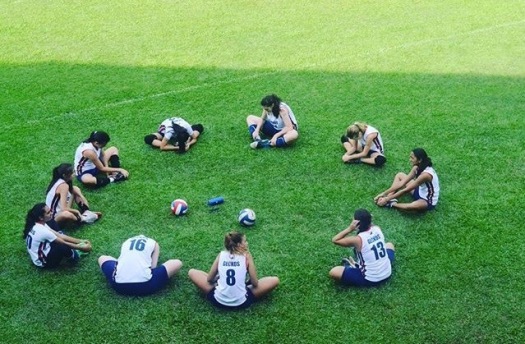
A huge benefit of the joint tournament was that all the teams had some sort of support and cheering system during matches. The picture below shows the girls' volleyball team watching the boys’ first match.

(Credit: Andre Joubert)

We started off with high hopes and expectations that were carried over from our undefeated win in last year’s tournament. Although we fought and played hard in our matches and practices, honing our individual and teamwork skills as much as possible, we unfortunately came in 6th place of an overall 8 girls’ teams.

IMG_3180

(Credit: Andre Joubert)

This year was my last year playing my favourite sport in high school, and although I am sad that we did not get a higher place in the tournament, I am extremely happy to have been able to play and have fun with my team, and get coached by some of the best coaches I have ever had for any sport.


IMG_3134
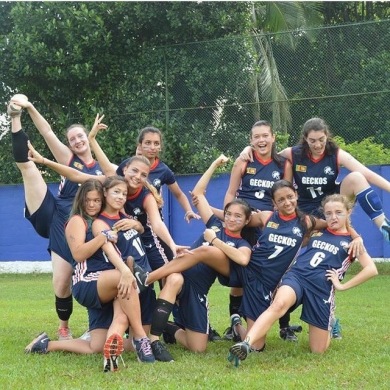
OSC SAISA Volleyball Team 2015

Wednesday, 7 October 2015

Monthly Update #1

Action: Volleyball

The volleyball season this year started off well enough, but the absence of last year’s seniors was pretty obvious. Our captain last year, Greta, who was an amazing player who we relied on almost a little too much, and one of our main setters and solid servers, Athena, were integral parts of our team, and their leaving greatly affected the team dynamics. Not only did we have to prepare for the arrival of new players we also had to shift from old positions.

(Credit: Andre Joubert)

Elizabeth and Prerna stepped up into leadership roles beautifully, and I am trying to become a solid power hitter and overhand server to make up for the loss of Greta’s and Athena’s skills in these areas. Last year I was a semi-reliable hitter and solid underhand server, but this year I was able to improve the power behind my spikes as well as their manoeuvrability and I recently upgraded from under- to overhand serves, although they are harder for me to aim than the underhand (Increased their awareness of their own strengths and areas for growth and Develop new skills).

(Credit: Andre Joubert)

This year’s team does not include any outstanding volleyball skills, so our main focus was to work on teamwork to make up for each other’s faults (Worked collaboratively with others). While this is a good strategy, it was hard to put into practice because of the lack of communication as well as the weak grasp of the basic skills such as receiving and serving. Communication in volleyball is key, as the cooperation between team members is dependent on whether or not they know what the others are doing, and the lack of it is probably to do with the new players being reserved about playing aggressively.

(Credit: Andre Joubert)

Greta’s strategy for bringing out aggressiveness in her players was to get into their space and try to make them mad. Sometimes she would run to the other side of the court shouting for the ball to prove this point. While this strategy helped me realize that the only way I would be able to get the ball was by communicating (loudly) what I was doing, it can be limited by the players reacting differently and becoming completely complacent and overly dependent on Greta playing the ball (which was the case for us when we realized how much her absence affected the team this year).

(Credit: Andre Joubert)

This focus on teamwork was tested during our practice matches against local schools, who were very reliant on a single star player like we were last year. We were also able to play against a team who normally plays professionally, and we learnt a lot during that match, such as how we need to work on properly covering the blockers and hitters to easily receive loose balls.

(Credit: Andre Joubert)

SAISA this year was initially supposed to take place in Dhaka, but because of security reasons it will be held here in Colombo. This is a huge advantage for us as we were practically scrambling for players that could get a travel visa for Bangladesh, and now we are able to play with a full team, which includes our power server Anna who was not allowed to travel. Playing as last year’s undefeated champions on our home turf is a little daunting, but I am confident that we will give our opponents a run for their money (Shown perseverance and commitment in their activities).

(Credit: Andre Joubert)
Service: Checkmates

Service this semester started off with the Service fair, where students could talk to the leaders of each service group to get a better idea of the different options available to them before choosing their group for the semester. After deciding last year that I would like to join a different group from Alzheimer’s (Undertaken new challenges), I settled on a new group called the Checkmates.

(Credit: Mr Lockwood)

The Checkmates’ general purpose is to teach chess skills to students from an underprivileged school so that they can have a better chance at winning a chess scholarship, which are very highly coveted and sought after in Sri Lanka (Engaged with issues of global importance and Considered the ethical implications of their actions).

The first few sessions involved getting to know each other and our service leaders, Arnold and Nela, and our supervisor, Mr Canizalez, as well as brushing up on our chess skills (Increased their awareness of their own strengths and areas for growth and Develop new skills). In recent sessions we began planning what we would do for the rest of the year, and making a presentation about chess for the students we would be teaching (Planned and initiated activities and Worked collaboratively with others).

 (Credit: Sho)

In the last session we were visited by students from Nalanda School who play chess extremely well, so that we can learn a bit more about the game to pass it on to the other school’s students.

Creativity: Piano lessons

My progress in achieving my goals for Creativity are slow going compared to Service and Action. While I am still developing my piano skills, I am still struggling with playing an entire piece perfectly, and my practice time is hampered by academics and other work (Increased their awareness of their own strengths and areas for growth).

The first step I need to take to complete my goal is to choose a particular piece to become fluent in, as opposed to what I was doing previously by trying to only adequately play a bunch of pieces (Planned and initiated activities). In regards to my goal of learning how to instinctively read sheet music, that can only be achieved through lots of practice (Shown perseverance and commitment in their activities).

Monday, 24 August 2015

My Goals V2.0

Creativity
  • Art Club: Last year I implemented this activity (which was then called the Drawing Club) into my CAS program before it was cancelled near the end of the year. Since I am no longer a part of the SGA, my focus on my art and drawing skills in the club will increase, and instead of using it as a non-stressful place to develop my art skills, I intend to set myself a few small goals or project and consciously improve myself. This could be making my own short comic book, learning more about different drawing styles like realism, and so on. This mind set for the Art Club incorporates the learning outcomes of: Increased their awareness of their own strengths and areas for growth, Undertaken new challenges, Planned and initiated activities, Shown perseverance and commitment in their activities, and Develop new skills.
  • Piano Lessons: I have taken these lessons since Gr 10 but failed to mention it in last year's goals list. What I would most like to achieve by the end of the year with this, is to completely master a complicated music piece and play it flawlessly. The same learning outcomes apply for both creativity activities.
Action

  • Volleyball, basketball & football: These are the same SAISA teams I have been in for the last couple years and I really like the sports and team dynamics that come from playing them. Unfortunately, this year will require me to focus more on academics, so it is unlikely that I will participate in basketball, and even more so in football as these two seasons are closer to the mocks and the actual exams. Luckily volleyball (my favourite sport) takes place early in the year, so I can participate in SAISA without worrying too much about my school work. These SAISA sports incorporate the learning outcomes of: Increased their awareness of their own strengths and areas for growth, Shown perseverance and commitment in their activities, Worked collaboratively with others, and Develop new skills

Service
  • Service: This year for service I intend to participate in a different one than Alzheimer’s. Hopefully something that works with children as I have realized (from WWW) that I really enjoy working with them as opposed to elderly people. Learning outcomes that are used for this are: Undertaken new challenges, Worked collaboratively with others, Shown perseverance and commitment in their activities, Engaged with issues of global importance, Considered the ethical implications of their actions, and Develop new skills.

Sunday, 7 June 2015

DP1 Final CAS Reflection

Increased their awareness of their own strengths of areas for growth
This outcome was one of the harder ones to achieve, as I had to make an objective judgement about myself, and how I have grown by identifying my strengths and fixing my weaknesses. Awareness of myself mostly had to do with the Activities section of CAS as I had to consciously work on my weaknesses and perfect my strengths through training and practice for SAISA.

Undertaken new challenges
Joining the Alzheimer’s Awareness Service Group was a bit of a challenge as I had never really interacted with patients suffering from Alzheimer’s disease before and am nervous by default around new people. Another new activity that I undertook was piano lessons. I had always wanted to play the piano when I was younger but became more disinterested as I became older, so learning to play was a challenge in and of itself, as well as sticking with it.

Planned and initiated activities
Though I did not take any major leadership roles in any of my CAS projects, I was still included in some of the decision making processes and event planning processes involved in Alzheimer’s and the Student Government Association.

Worked collaboratively with others
Collaboration was immensely important in the sports teams that I was a part of. Teamwork is an integral part of basketball, football and volleyball as they are team sports. Collaboration was also used a lot in the SGA, not just in the group but also with the SCN (School Connection Network), the school staff and other groups to plan and create an event.

Shown perseverance and commitment in their activities
Commitment applied to all of my CAS projects, as dedication is very important to the different activities. I tried to attend all the sessions that I could because being present is just as important as collaboration and participation. Perseverance was a bit of a challenge for me with regards to piano lessons as I was not as interested in it as I was when I was younger.

Engaged with issues of global importance
This learning outcome was mainly applied to my work in the Alzheimer’s service group as the disease is an occurrence worldwide and raising awareness for it and caring for the people suffering from it is equally important around the world.

Considered the ethical implications of their actions
Questions of ethics came up a lot during sessions in Alzheimer’s. For example, was our continued visitation of the Alzheimer’s centre beneficial to the patients? Were we unwittingly causing further damage or causing the patients to feel bad about their disease? Was the entire process done to help the patients or to make ourselves feel better?

Developed new skills
When undertaking any new activity, a new set of skills need to be developed to meet the challenge. For example, in SGA I needed to learn about advertising and marketing events and how to take minutes in a meeting.

Next year for the DP2 I hope to make as much time for CAS as I did this year, but this is unlikely as I will be focusing more on my studies near the end of the year. Hopefully next year I will also focus more on reflecting and updating my blog more than I did this year. Though I did not complete all of my goals, I am still satisfied with my CAS work this year, and hope to do just as well in the following year.